STI and STD testing in Bali: discreet, at your villa, no judgement
Sexual health is one of the most common things doctors here are asked about, and most of what turns up is easy to treat once it has a name. An STI test (the newer term for an STD check) needs no clinic, no waiting room and no awkward conversation with a stranger at reception. The timing is the part most people get wrong, so this guide starts there, then covers what a villa test involves, how fast results come back, and what happens after a positive.
Straight answer
You can arrange a full STI test in Bali without setting foot in a clinic: a trained professional collects blood, urine or swab samples at your villa or hotel, usually the same day, and a licensed doctor explains the results privately on a video call. Timing decides what a test can see: chlamydia and gonorrhoea show up about 2 weeks after exposure, HIV and syphilis take 3 to 12 weeks. Most infections cause no symptoms at all, so testing is the only way to know. If something is found, Bali Doc's doctors talk you through it and arrange treatment where it is appropriate, and the first GP consultation is free.
Talk to a doctor about testing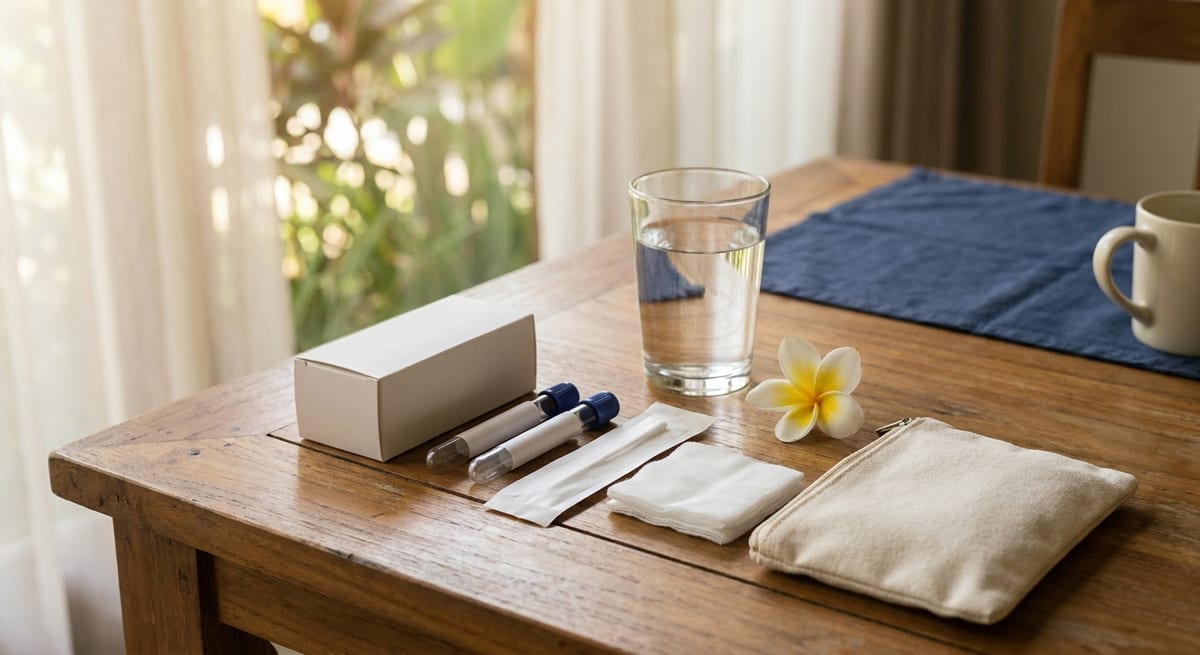
Why test if you feel completely fine?
Most people picture an STI as something you would obviously notice. The common ones are the opposite. Chlamydia and gonorrhoea frequently cause nothing at all, especially early on, and HIV and syphilis can stay quiet for years. You can feel perfectly well, carry an infection, and pass it on without ever knowing it was there.
Silent does not mean harmless. Untreated chlamydia and gonorrhoea can travel up to the pelvic organs and cause pelvic inflammatory disease, which is painful and can affect fertility; in men the same infections can inflame the epididymis and produce a very sore, very swollen testicle. Syphilis moves slowly and seriously when it is missed. Caught early, every one of these is far easier to deal with.
Which is why doctors suggest a check after any new partner. It takes a few minutes and beats waiting for a problem to announce itself.
Which symptoms should prompt a test?
Some infections do show themselves. Test promptly if you notice:
- Unusual discharge from the genitals
- Burning or pain when passing urine
- Sores, blisters, warts or lumps around the genitals, anus or mouth
- Itching, irritation, or bleeding you were not expecting
- Pain low in the abdomen or pelvis, or pain during sex
- Discomfort, discharge or bleeding from the rectum after anal sex
- A sore throat that hangs around after oral sex, especially with no cold to explain it
Careful with the second one: burning when you pee is also the classic sign of a urinary tract infection, which is common in Bali and very treatable. We have covered UTIs in Bali separately. The reverse trap matters more, though. No symptoms does not mean no infection.
A doctor can talk it through in private and build a panel around what actually happened, rather than a scattergun list. Prefer to ask by message first? WhatsApp us.
The condom broke: what to do in the next 72 hours
Time matters more here than anywhere else in this article. The clock started at the exposure, not at 3am when you began worrying about it, and two of the useful options expire before the weekend is over.
- Preventive medication against HIV has to start within 72 hours. Sooner is better: started the next morning it is far more use than at hour 70. It is a prescription course taken for several weeks, and a doctor decides whether it is warranted after asking what happened, with whom, and how likely the exposure really was. It is not something you pick up off a shelf, so open that conversation immediately rather than waiting for a clinic to unlock its doors.
- Where pregnancy is a possibility, emergency contraception works best the sooner it is taken. One type is used up to 72 hours after sex, another stretches to five days, and a copper coil fitted by a clinician is the most effective option inside that five-day window. Which one suits you depends on the timing, your weight and the contraception you normally use, so it is worth two minutes of advice rather than a guess at a pharmacy counter.
- Wash normally and leave it at that. Douching, scrubbing or antiseptics do nothing to lower the risk of an infection and can irritate the tissue enough to make one easier to catch.
- Say early if blood was involved, if the condom failed during anal sex, or if you know the other person has HIV or hepatitis B. Each of those changes the advice.
Then the calendar. Testing the next morning tells you almost nothing about last night, because every infection needs time to become detectable. Chlamydia and gonorrhoea from about two weeks. An early HIV test at about four weeks catches most infections. Twelve weeks closes the file on HIV and syphilis whatever test was used. Book those dates in your phone now, while you still care about them.
One piece of logic worth having ready: if you were exposed last night and you have symptoms this morning, those symptoms belong to something earlier. Get seen for them anyway.
If sex was not consensual, or if you were hurt, please go to a hospital emergency department rather than arranging anything online. They can handle the medical side and the evidence side together, at your pace, and you deserve that level of care.
When should you test? Window periods explained
Every infection has a window period: the stretch between catching it and the point a test can reliably pick it up. Test too early and you can walk away with a clear result while an infection is quietly establishing itself. This is the single most common mistake people make with STI testing.
The figures below are typical guides for modern laboratory tests. Your doctor will confirm what applies to you, because the exact window depends on the test used.
| Infection | Sample | When a test becomes reliable |
|---|---|---|
| Chlamydia | Urine, or a genital, throat or rectal swab | About 2 weeks after exposure |
| Gonorrhoea | Urine, or a genital, throat or rectal swab | About 2 weeks after exposure |
| Syphilis | Blood | From about 3 weeks; a test at 12 weeks gives the final answer |
| HIV | Blood | From about 4 weeks, and often conclusive by about 6 weeks with a laboratory test; 12 weeks settles it whatever the test type |
| Hepatitis B | Blood | From about 6 weeks; your doctor may advise a later re-test to be completely sure |
Not all HIV tests are the same, which is where a lot of internet anxiety comes from. The laboratory test used here looks for both the virus's own protein and your antibodies to it (the fourth-generation test), so it turns positive earlier than the antibody-only finger-prick kits sold over a counter. A negative finger-prick test at three weeks means much less than a negative laboratory test at six.
Herpes is the odd one out. It is diagnosed by swabbing a sore while the sore is there, so a blister or ulcer is worth showing a doctor the same week rather than waiting for it to settle. Routine blood screening for herpes is rarely useful.
If you are anxious you do not have to sit out the whole window doing nothing. An early test for peace of mind, followed by a planned re-test once the window has passed, is a normal plan. Doctors arrange this all the time.
Do you need a throat or rectal swab?
A urine sample only tells you about the urethra. If gonorrhoea is sitting in the throat after oral sex, or chlamydia in the rectum after anal sex, a urine-only panel comes back clean and the infection stays exactly where it is, silently, and gets passed on. Throat and rectal infections almost never cause symptoms. That is precisely why they get missed, and why a reassuring result from the wrong sample site is worse than no result at all.
The laboratory method is the same wherever the sample comes from: PCR, also written NAAT, which looks for the organism's genetic material rather than your body's reaction to it. Only the sample changes. A throat swab is a few seconds at the back of the mouth and makes most people cough. A rectal swab goes in a couple of centimetres and is over faster than reading this sentence; in most cases you can take it yourself, behind a closed door, and hand it over in a sealed tube.
So when the doctor asks what kind of sex you had, that question is doing a job: it decides which tubes get sent to the lab. You can answer it in five words and move on.
What does an STI test at your villa involve?
It starts with a private video consultation with a licensed, English-speaking doctor. You give the rough dates, the type of contact and any symptoms, and the doctor puts together a panel that fits, rather than selling you the full menu. That first GP consultation is free, so at the testing stage the only thing you pay for is the lab work you agreed to.
Then someone comes to you. A trained professional collects the samples at your villa or hotel, anywhere from Canggu to Ubud, usually the same day you spoke to the doctor. It takes a few minutes and looks like any other home visit: a small blood sample, a urine pot, a swab or two. Nothing on the bag says what it is for.
Cost depends entirely on which tests you choose. A focused panel aimed at one specific exposure usually sits at the cheaper end; a full screen with every site swabbed costs more. The exact figure is calculated and confirmed with you before anything is collected or paid, and current service pricing sits on the pricing page.
Turnaround depends on the test. Rapid blood screening (HIV and syphilis) can come back within hours. PCR panels typically take one to three working days, and weekends slow laboratories down here as everywhere, so a Saturday sample often means a Tuesday answer.
When the results land, the doctor explains them on a video call, in plain English, with time for questions, and you get the written report to keep. Results go to you and nobody else, and no one involved will raise an eyebrow. Nothing you say will be new to them.
What happens if a result is positive?
A positive result is far less dramatic in practice than in the imagining. It is information, and for the common infections it turns into a plan the same day.
Chlamydia, gonorrhoea and syphilis are bacterial, and they are treated with antibiotics, sometimes as a single injection rather than a course of tablets. Gonorrhoea in particular usually means an injection, and it earns a follow-up test to confirm the infection has cleared, because resistant strains circulate widely in Asia and a treatment that worked five years ago cannot be assumed to work today. That test of cure is done at least two weeks after treatment, sometimes later: swab too soon and the PCR can still pick up fragments of dead organism and frighten everybody for no reason.
Wait seven days after treatment before having sex again, and until any partner has been treated too. An infection ping-ponging between two people looks exactly like a treatment failure and is not one. Reinfection is common and says nothing about the medicine.
Viral infections work differently. Herpes can be managed so outbreaks are shorter, milder and less frequent. HIV, especially when caught early, is now a long-term condition managed with daily treatment that, taken properly, brings the virus down to a level where it cannot be passed on to a partner. That is specialist care, and the job of the doctor who gives you the result is to get you into it rather than leave you googling at midnight.
Where treatment is needed, the doctor prescribes at their own discretion and a licensed, BPOM-registered partner pharmacy dispenses the medication and delivers it discreetly to your door. A doctor's assessment is required before any prescription. Some medication, including controlled substances, requires a specialist consultation and may be restricted under Indonesian law.
A licensed doctor can review it, tell you what it means for you, and arrange treatment where it is needed.
How do I tell a partner?
This is the part people dread most, and it is nearly always easier than the version rehearsed in your head. STIs are extremely common, and catching one says nothing about who you are. A positive result also does not tell you who had it first: several infections sit silently for months or years, so a result is rarely proof that anyone was unfaithful.
Telling recent partners matters because they may be carrying the same infection with no symptoms, and because treating one half of a couple lets the infection come straight back. Short and factual beats apologetic. Something like this is plenty:
"I had a sexual health check this week and chlamydia came back positive. It is easy to treat, but you should get tested too, and I would rather you heard it from me than found out later."
Then there is the holiday version, where you have a first name, a bar in Canggu and no way to reach anyone. Tell who you can tell, and let the rest go. What remains in your hands is your own treatment and your own re-test, and that is the part that protects people. If you want help finding the words, ask the doctor. They have talked many people through this exact conversation.
What if you fly home before your results arrive?
The results call is on video, so it works from Bali, Sydney or Amsterdam; you just pick a time that is not 4am where you are. If you are still in Indonesia when a positive comes back, whether you have moved on to Jakarta or are still in Bali, treatment can usually be arranged and delivered without you changing your plans.
If you have already left, ask for the written report before you fly and email it to yourself. Your doctor at home will want to know which infections were tested for, which laboratory ran the samples, and the date the sample was taken. With those, most doctors will act on the result, though some prefer to repeat a test on their own system, which is reasonable and not a slight on the first one. Worth noting if your trip is short: a twelve-week re-test will often fall after you get home, so make the appointment before the date stops feeling urgent.
Symptoms that stay when the tests come back clear
A negative panel and ongoing symptoms is a real and frustrating combination, and it usually means the right test has not been run yet. Trichomoniasis and Mycoplasma genitalium both need their own PCR test and are not on every standard screen. A urinary tract infection can imitate an STI almost perfectly, which is why the UTI guide is worth a read if burning when you pee is the main problem. Thrush, a new soap or lubricant, shaving, friction and plain sunburn account for a fair share of the rest.
Go back to the doctor with the report in hand rather than starting from zero somewhere else. What has already been excluded is useful information, and it usually shortens the second consultation to a few minutes.
Preventing STIs while you travel
No single measure is perfect, but a few habits stack the odds firmly in your favour:
- Condoms remain one of the most effective everyday protections against most STIs, and they cost almost nothing at any minimarket or pharmacy in Bali. Heat and friction are hard on latex, so the one that has spent a fortnight in a wallet or under a scooter seat is not the one to rely on. Check the date on the foil.
- Vaccination covers ground that condoms cannot, including HPV and hepatitis B. If you missed those at home, a clinician can tell you whether catching up is worthwhile at your age.
- Regular testing when you have a new partner catches silent infections early and protects the people you are with, which is the whole point.
- Preventive medication against HIV, taken daily or around specific events, suits some people very well. It needs baseline blood tests and periodic checks, so it is a conversation with a doctor rather than something to arrange on holiday whim.
- Most broken-condom stories start with a long night. Decide about condoms before the fourth drink, not after it.
When to seek urgent care
Most sexual-health questions are routine. A few are not, and deserve prompt in-person attention:
- Sudden, severe testicular pain or swelling: go to an emergency department immediately. A twisted testicle can only be saved within a few hours.
- Severe lower-abdominal or pelvic pain, especially with a fever
- Possible symptoms of infection during pregnancy: some infections need particular care when you are pregnant, so see a doctor promptly
- A possible HIV exposure within the last 72 hours: speak to a doctor immediately, for the reasons set out earlier. This one is measured in hours, not days.
- A rash on the palms or soles, with or without a fever, is not an emergency but should not be waited out. It is one of the ways syphilis announces itself.
- If sex was not consensual: please seek in-person care as soon as you can. You deserve proper medical care and support, at your own pace, and a doctor can help you take the next steps.
Look after yourself
Because so many infections are silent, a test is the only way to know where you stand, and in Bali it does not even require leaving your villa. Pick a date that clears the window period, have the samples taken, and let a doctor read the result to you properly. For most people the outcome is a clear panel and an evening they finally stop replaying.
General information, not medical advice. Testing, diagnosis and treatment should be carried out by a licensed clinician based on your individual circumstances.
Frequently asked
How soon after exposure can an STI test detect an infection?
It depends on the window period: the gap between exposure and the point a test turns reliably positive. Chlamydia and gonorrhoea are usually detectable about 2 weeks after exposure. Syphilis blood tests become reliable from about 3 weeks, with a final check at 12 weeks. Modern laboratory HIV tests pick up most infections from about 4 weeks and are often conclusive by around 6 weeks, while a test at 12 weeks settles the question whatever the test type. Testing early for peace of mind and re-testing once the window has passed is a completely normal plan.
The condom broke last night. What should I do?
Talk to a doctor now rather than in the morning. Preventive medication against HIV has to start within 72 hours of the exposure and works better the earlier it begins, so it is a same-night conversation, not a same-week one. Where pregnancy is possible, emergency contraception also works best the sooner it is taken. Testing comes later: about 2 weeks for chlamydia and gonorrhoea, about 4 weeks for an early HIV test, and 12 weeks for the final all-clear. A test the next morning tells you about your previous partner, not last night.
Can I have an STI without any symptoms?
Yes, and it is very common. Chlamydia and gonorrhoea often cause nothing at all, and infections such as HIV and syphilis can stay silent for years. You can feel completely well, still carry an infection, and pass it on. Throat and rectal infections are quieter still. Testing is the only reliable way to know, which is why doctors suggest a routine check after any new partner.
Can I get an STI test at my villa in Bali?
Yes, and it can usually be arranged the same day you speak to the doctor. A trained professional comes to your villa or hotel anywhere in Bali to collect what is needed: a small blood sample, a urine sample, or a swab. A licensed, English-speaking doctor then explains your results privately on a video call. No clinic, no waiting room, no reception desk.
Do I need a throat or rectal swab?
If you have had oral or anal sex, yes, it matters. A urine sample only tests the urethra, so gonorrhoea in the throat or chlamydia in the rectum can be missed entirely by a urine-only panel, and both are usually silent. The swab takes seconds, uses the same PCR (also called NAAT) laboratory method as the urine test, and in most cases you can take it yourself. This is why the doctor asks what kind of contact you had: without that, they are choosing sample sites blind.
How much does STI testing cost in Bali, and how long do results take?
Your first consultation with a Bali Doc GP is free, and the doctor recommends a panel that fits your situation instead of a list of everything. Lab pricing depends on which tests you choose: a focused panel aimed at one exposure costs far less than a full screen with every site swabbed. The exact figure is calculated and confirmed with you before anything is collected or paid. Rapid blood screening can come back within hours; PCR panels typically take 1 to 3 working days.
Is STI testing in Bali confidential?
Yes. Sexual-health testing is handled with the same confidentiality as any other medical care. The consultation is private and results go to you and nobody else. Clinicians deal with these questions every day, and nothing you ask will surprise them.
What happens if my STI test is positive?
The doctor explains what the result means and what happens next. Chlamydia, gonorrhoea and syphilis are bacterial and treatable, sometimes with a single injection rather than tablets, and for gonorrhoea a follow-up test to confirm the infection has cleared is standard practice because resistant strains circulate in Asia. A doctor's assessment is required before any prescription. Some medication, including controlled substances, requires a specialist consultation and may be restricted under Indonesian law. Where treatment is appropriate, a licensed BPOM-registered partner pharmacy dispenses and delivers it discreetly.
What if I fly home before my results arrive?
The results call happens on video, so it works from Bali, Sydney or Amsterdam. If you are still in Indonesia, whether in Bali or Jakarta, treatment can usually be arranged and delivered. If you have already left, ask for your report in writing and take the details your doctor at home will want: which infections were tested for, which laboratory ran them, and the date the sample was taken.