Bringing prescription medication to Bali: the customs & BPOM rules
Planning a trip to Bali and worried about your medication? This guide covers what you can bring and how much, the documents and declaration you need, which medicines are restricted, and how to have yours already arranged when you land.
The short answer
You can usually bring a personal supply (around 30 to 90 days) of most prescription medication into Indonesia in its original packaging, with a copy of your prescription or a doctor's letter, declared on the e-CD customs form where required. But opioid painkillers (including codeine), amphetamine-type ADHD medicines and cannabis products are banned, and sleep and anxiety medications are tightly restricted. If yours is on those lists, or you'd rather land with everything sorted, a licensed Indonesian doctor from Bali Doc can arrange a legal local supply before you fly, whether you arrive in Bali or Jakarta.
Book your free pre-departure consultationOr WhatsApp us the name on the box and we'll check it for free.
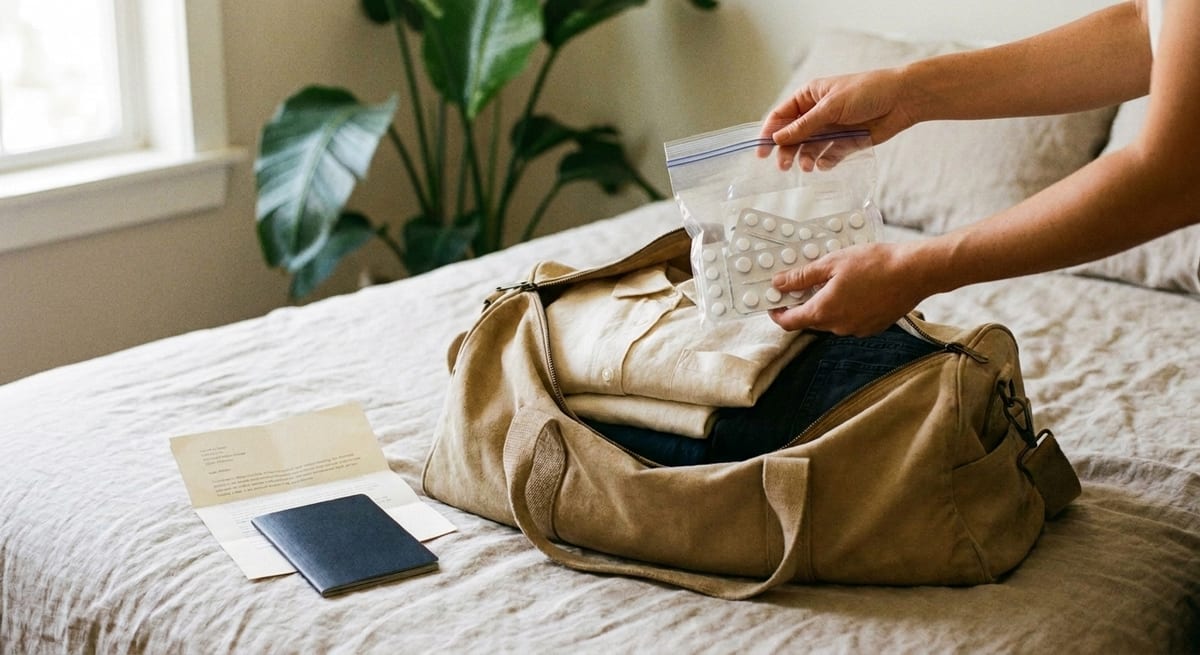
Can you bring your own medication into Bali?
For most everyday prescription medicines, yes, provided you carry a reasonable personal quantity and the paperwork to prove it's yours. Indonesia regulates medicines through BPOM (Badan Pengawas Obat dan Makanan, the National Agency of Drug and Food Control), and customs officers can ask any traveller to declare and justify the medication they carry. The rules are national, so they're identical whether you land at Ngurah Rai in Bali or Soekarno-Hatta in Jakarta.
Getting it wrong ranges from unpleasant (your medicine held or confiscated) to genuinely serious: Indonesia has strict drug laws, and "it was prescribed at home" is not a defence for a prohibited category. The good news is that with a little preparation, or one short consultation before you fly, this is an easy problem to avoid. The rules below reflect current BPOM and customs guidance; they change from time to time, so check official sources close to your travel date.
The general rules, in plain language
- Personal use only. You may carry medication for yourself (or a family member travelling with you), in quantities that match the length of your stay.
- Original packaging. Keep every medicine in its original, labelled pharmacy packaging. Loose pills in an unmarked organiser are the fastest way to raise questions.
- Paperwork matters. Carry a copy of your prescription, or a doctor's letter covering each medicine, its dose, and that it's prescribed for your personal use.
- Hand luggage, always. Medicines and their documents travel in the cabin with you. Checked bags go missing, sit on hot tarmac and can't be opened mid-flight.
- Declare when asked. Indonesia uses an electronic customs declaration (e-CD) completed before or on arrival. Medication, especially anything controlled, belongs on it. Declaring costs nothing; failing to declare is what creates problems.
- Never mail medication to Indonesia. Posting or couriering medicines to yourself is treated as importation, not personal use, and packages are scrutinised. Don't do it, before or during your trip.
How much can you bring? The quantity limits
The allowance depends on what kind of medicine it is:
| Type of medicine | Allowed? | Typical limit |
|---|---|---|
| Regular prescription medicines (blood pressure, cholesterol, thyroid, diabetes, asthma inhalers, reflux, antidepressants, epilepsy medicines, contraception and hormone therapy, and similar) | Yes, with prescription | Up to about a 90-day supply (a commonly cited guideline, not a hard legal limit) |
| Psychotropic medicines (most sleep and anxiety medications, some ADHD stimulants) | Restricted: prescription + declaration required | Around a 30-day supply maximum |
| Narcotic-class medicines (opioid painkillers including codeine, amphetamine-type stimulants, cannabis-derived products) | Effectively not permitted for travellers | None without special advance authorisation |
| Over-the-counter medicines without a prescription | Yes | A small, clearly personal quantity; guidance has cited around 30 dosage units per item |
The 90-day figure is a commonly cited guideline for what customs considers a reasonable personal supply, not a number printed in the law. Carrying much more than your stay plausibly requires invites scrutiny even for harmless medicines.
The active ingredient decides the category, not the brand name. The same medicine is treated the same way whichever country dispensed it, so know your medicine's generic name; it's the first thing an Indonesian doctor or customs officer looks for on the box.
Injectable medicines (diabetes pens, weight-loss injector pens, hormone injections) follow the rules of their category. Carry them in hand luggage with your doctor's letter, and ask your pharmacist about keeping them cool in transit; more on that below.
Send us the name on the box and a licensed doctor will check it against the current rules, free.
Which medications are restricted or banned in Indonesia?
Indonesia schedules controlled medicines under two laws, the Narcotics Law (Law No. 35 of 2009) and the Psychotropics Law (Law No. 5 of 1997), and several medicine groups that are routine elsewhere are tightly restricted or not permitted here:
- Opioid painkillers, including codeine. This is the one that catches travellers out most: codeine-containing painkillers and cough syrups sold over pharmacy counters in some countries are narcotics under Indonesian law. For travellers they are effectively prohibited without special advance authorisation.
- ADHD stimulant medications. Amphetamine-type stimulants are treated as narcotics in Indonesia and banned outright, with no personal-use allowance. Some other ADHD stimulants are psychotropics: a small declared supply with full documents may be accepted, but never assume; verify your exact medicine before you fly.
- Sleep and anxiety medications (benzodiazepines and related sedatives). Also psychotropics: small declared quantities with documentation at most.
- Cannabis-derived products of any kind, including oils, edibles and creams that are legal or sold over the counter at home. Indonesia treats cannabis as a narcotic with zero tolerance. Never bring any of it, in any form.
If your medication is in one of these groups, bringing it without the correct permits can mean prosecution under Indonesia's narcotics law, a far heavier outcome than losing a box at the customs desk. It's the single most common problem we help travellers untangle, and it's almost always avoidable with a week's notice. If ADHD medication is your concern and you'll be in Bali a while, our guide to focus and ADHD care in Bali covers your options once you're here.
Check your painkillers before you pack
The codeine problem hides in ordinary washbags. In Australia, the UK and plenty of other countries, combination painkillers and night-time cough syrups sold over pharmacy counters contain codeine, and most people have never read the small print on a box they've bought for years. Before you pack, pick up every pain, cold and flu product going into your bag and read the ingredients line. If you see codeine (often listed as codeine phosphate), leave that product at home; a plain codeine-free painkiller does the same job for a headache and raises no questions at all. Do the same for a partner's or a child's washbag if you're packing for the family.
What documents do you need for medication at Indonesian customs?
- Doctor's letter (what Indonesian officials call a surat keterangan dokter) on letterhead, dated, listing each medicine, its dose, your condition in general terms, and that it's for personal use. English is fine; documents in other languages should be translated into English or Bahasa Indonesia. For ordinary customs checks, no notarisation or embassy legalisation is needed.
- Copy of each prescription (paper or a clear photo on your phone), in the same name as your passport and boarding pass.
- Original pharmacy packaging with the dispensing label matching your name.
- Medication information sheets (optional, helpful if an officer doesn't recognise an unusual medicine).
- A wallet card listing your medicines, conditions and your doctor's contact details. Customs will never ask for this one; it's for paramedics and ER staff if something goes wrong.
And the don'ts
- Don't transfer pills into unmarked containers.
- Don't carry medication prescribed to someone else.
- Don't exceed the quantity limits for the category.
- Don't mail or ship medication to Indonesia, before or during your trip.
Packing medication for the flight (and the Bali heat)
Where and how you pack matters almost as much as what you bring:
- Liquids, gels and injections. Medically necessary liquids are exempt from the 100 ml cabin limit: declare them at security, keep them together in a separate clear bag with your doctor's letter, and allow a few extra minutes.
- Medicines that must stay cool. Injectable pens and other temperature-sensitive medicines need a cold-chain plan for the journey; the next section covers it in detail.
- After you land. Bali is hot and humid, and heat degrades some medicines. Don't leave medication in a parked car or a beach bag; a cool drawer or the room safe is enough for most medicines.
What about insulin, contraception or children's medication?
Insulin and other injector pens survive long transits better than people fear, but a Bali trip from Europe or North America is often 30 hours door to door across two or three legs, which is longer than a pen should spend warm. Ask your pharmacist for a proper travel cool case (the gel-lined ones hold temperature far longer than an improvised ice pack), keep every pen in hand luggage, and on long legs you can ask cabin crew whether the galley fridge is an option. Some airlines will help, some won't, so the cool case is the plan and the fridge is a bonus. When you land, move the pens to the hotel or villa fridge, not the freezer compartment. Dose timing needs thought too: Bali is a large time-zone jump from Europe and the Americas, so ask the doctor who manages your treatment how to shift your schedule before you leave, rather than improvising at 2 am in transit.
Contraceptive pills and hormone therapy count as regular prescription medicines here: bring your supply with the usual paperwork and customs won't blink. What catches people out is continuity (running out in week five of a six-week stay) and timing, since a 7 or 8 hour shift can stretch the gap between pill doses further than some pills tolerate. Our guide to hormone health while travelling in Bali covers both.
Children's medication travels under the same family-member rule as your own: a parent can carry a child's medicines when you're travelling together, with the prescription or letter in the child's name. Keep liquid medicines in their original packaging with the dispensing label, and pack more than the trip strictly needs; children's formulations and doses are the hardest to match exactly at a local pharmacy.
How do you declare medication on Indonesia's e-CD form?
Indonesia's electronic customs declaration (e-CD) lives at ecd.beacukai.go.id and opens for completion in the few days before you arrive (currently three). You can also fill it in at the airport by scanning one of the QR posters before the customs channel, though doing it from your sofa beats doing it in a queue after a red-eye. The form takes your passport and flight details, then asks a series of yes-or-no questions about what you're carrying; the one covering narcotics, psychotropics and other restricted goods is where declared medication belongs. Answer yes and list it. Submitting gets you a QR code: screenshot it, because airport wifi is not something to rely on at 6 am.
At Ngurah Rai the QR is scanned at the machines just before the arrivals exit, after immigration and baggage claim, and most declared travellers are waved straight through. If an officer does stop you, the exchange is shorter than the anxiety that preceded it. It runs along the lines of "what is this medication?" and "do you have a prescription?", and your answer takes two sentences: name the condition in plain words and hand over the paperwork. "It's my blood-pressure medication, I take it every day. Here's the prescription and my doctor's letter." That ends the conversation in the vast majority of cases. Officers see travellers' medication all day; declared and documented is the boring, forgettable outcome you're aiming for.
If your medicine needs special permission: start weeks ahead
For restricted medicines there is a formal route: contact an Indonesian embassy or consulate well before travel, with a detailed doctor's letter and the exact quantity you need. Requests involving narcotic-class medicines run through the Indonesian authorities (BPOM and the National Narcotics Agency, BNN), take weeks rather than days, and approval is not guaranteed. Indonesia also operates a Special Access Scheme for medicines not registered locally, which allows limited personal-use quantities with BPOM approval, though it does not override the narcotics rules. If that sounds heavy for a holiday, the practical alternative is below.
Have it arranged before you land
Most people reading this haven't flown yet, which is the ideal position to be in. Rather than gamble at customs or spend weeks on permits, book a free pre-departure consultation: a licensed Indonesian doctor reviews your medication, confirms what's possible and, where appropriate, arranges a legal local equivalent through a licensed pharmacy so it's ready when you arrive. An Indonesian prescription is valid at any licensed pharmacy in the country, so this works whether you land in Bali or Jakarta.
Book your free pre-departure consultationWhat if my medication isn't allowed, or I run out in Bali?
Start with the fact that surprises almost everyone: your prescription from home is not valid in Indonesia. An apotek (pharmacy) cannot legally dispense against a foreign prescription, however official the paperwork looks; only a prescription written by an Indonesian-licensed doctor works at an Indonesian pharmacy counter. So "I'll just refill it when I get there" falls apart at the first pharmacy you visit. You'll need an Indonesian doctor's assessment first, and you can have that done before you fly.
With that understood, you have good options, and you don't need to go without:
- Get a local equivalent prescribed. A licensed Indonesian doctor can assess you and, where appropriate, prescribe a legal, locally available alternative. Many international medicines have direct equivalents registered with BPOM, usually under a different local brand name, which is why knowing your generic name helps.
- Have it delivered. Medication is dispensed by a BPOM-registered partner pharmacy and delivered to your hotel or villa, often the same day.
- Lost or forgot your medication? The same applies: a quick video consultation and it's sorted.
- Something unavailable locally? The doctor will tell you honestly and discuss the closest clinically appropriate option, rather than leaving you guessing.
On the ground this is less exotic than it sounds. Bali's towns are full of licensed apotek, from national chains like Kimia Farma, Guardian and Century to independents, and most everyday medicines are registered with BPOM under local brand names. Prices cut both ways: many routine generics cost less here than at home, while some imported branded medicines cost noticeably more, and you'll see the exact price confirmed before anything is dispensed. When a doctor reviews your medication, expect the doctor to ask for the generic name, your dose, how long you've been taking it, and who prescribed it last. Have the box or a photo of the label ready and the review takes minutes.
Worth knowing: A doctor's assessment is required before any prescription. Some medication, including controlled substances, requires a specialist consultation and may be restricted under Indonesian law. Doctors prescribe at their own discretion, so outcomes depend on your assessment.
A doctor can assess you by video and, where appropriate, arrange dispensing and delivery to your hotel or villa, often the same day.
What happens if you get it wrong
For routine medicines with missing paperwork, the usual outcome is questioning and possible confiscation: unpleasant, but recoverable (a local doctor can re-prescribe the same day). For undeclared controlled substances the situation is different: Indonesia treats narcotics offences severely, and a foreign prescription is not a defence for a prohibited category. That asymmetry is the whole reason to spend ten minutes checking before you fly.
When should you start sorting your medication?
Later than four weeks before the flight, the embassy route for narcotic-class medicines gets tight. Everything else has comfortable margins.
- Four weeks out: list every medicine you take by its generic name and place it in a category using the table above. Regular prescription medicine: pack up to about 90 days' worth with your prescription. Psychotropic: plan a 30-day supply, full documents and a declaration. Narcotic-class: don't pack it; arrange a local alternative with a doctor, or start the embassy authorisation now.
- Two to three weeks out: book a free pre-departure consultation if anything on your list is restricted, unavailable, or something you'd rather not carry. This is also the moment to ask your doctor at home for the letter.
- 72 hours out: the e-CD portal opens. Fill it in, screenshot the QR.
- Day of travel: medicines and documents in hand luggage, cool case packed last, washbag checked for codeine.
Official sources worth checking
- Indonesian Customs (Bea Cukai), including the electronic customs declaration.
- BPOM, Indonesia's National Agency of Drug and Food Control.
- U.S. State Department: Indonesia country information (drug-law warnings for travellers).
- Australian TGA: travelling with medicines (a good checklist for what to carry, in any direction).
- Your nearest Indonesian embassy or consulate, for restricted-medicine authorisation.
Before you fly
Bring a personal supply of routine medication with your prescription and original packaging, keep everything in your hand luggage, declare what needs declaring, and you'll usually be fine. If your medicine is in a controlled or psychotropic category, don't gamble at customs: book a free pre-departure consultation and land with a legal supply already arranged, in Bali or Jakarta.
This article is general information, not legal or medical advice. Customs and BPOM rules change. Always check official sources before travelling.
Frequently asked
Can I bring my prescription medication into Bali?
Usually yes. Indonesia allows a personal supply (roughly 30 to 90 days depending on the medicine) carried in original labelled packaging, with a copy of your prescription or a doctor's letter, declared on the e-CD customs form where required. Narcotic-class medicines are the exception: for travellers they are effectively not permitted.
How much medication can I bring into Indonesia?
Up to about a 90-day supply of regular prescription medicines (a commonly cited guideline rather than a hard legal limit), around a 30-day supply of psychotropic medicines (with prescription and declaration), and a small, clearly personal quantity of any over-the-counter medicine; customs guidance has cited figures around 30 dosage units per item. Carrying much more than your stay plausibly needs invites questions at customs.
Which medications are banned or restricted in Indonesia?
Opioid painkillers (including codeine, even in products sold over pharmacy counters elsewhere), amphetamine-type ADHD stimulants and all cannabis-derived products are banned for travellers without special authorisation. Sleep and anxiety medicines and some other stimulants are psychotropics: a small declared supply with documents at most.
Do I need to declare my medication at Indonesian customs?
Declare psychotropic or controlled medicines on Indonesia's electronic customs declaration (e-CD), completed online shortly before arrival or via QR code at the airport. Keep your doctor's letter and prescriptions in your hand luggage. Declaring is free and takes a minute. Problems start when controlled medicines turn up undeclared.
Can I have my medication arranged before I arrive in Bali or Jakarta?
Yes. Book a free pre-departure consultation: a licensed Indonesian doctor reviews your medication, confirms what is possible and, where appropriate, arranges a legal local equivalent through a licensed pharmacy so it is ready when you land. An Indonesian prescription is valid at any licensed pharmacy in the country, so this works for Jakarta as well as Bali.
What if I run out of medication while I'm in Bali?
Don't go without. A licensed doctor can assess you by video and, where appropriate, prescribe a locally available equivalent, dispensed by a BPOM-registered pharmacy and delivered to your hotel or villa, often the same day.